
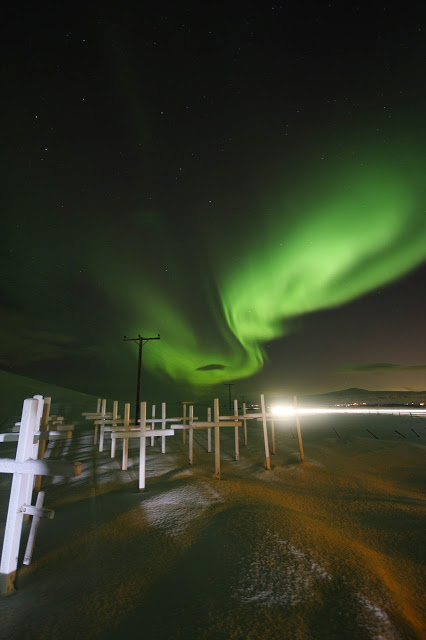
Experiencing the magic of the Northern Lights is on many a soul’s bucket list, and for good reason. The auroras are ethereal, magical, and mesmerizing. The Bride first experienced them on a winter night in Alaska while flying. For me, it came during a trip we took to Iceland (see photo above).
Seeing the Northern Lights, what Icelanders refer to as the auroras, is kinda like fishing: It has to be the right season, you have to be in the right place, and you have to have a little luck.
The Northern Lights develop when energized particles from the Sun interact with the Earth’s magnetic field. As gorgeous as the lights are, they are vestiges of the Sun trying to kill us! The spewing of particles from the sun is not uniform; therefore, the Northern Lights are not uniform. Because sunspots are an indication of solar activity and solar activity is directly related to solar storms and because sunspots follow an 11-year cycle, some “seasons” (parts of the cycle) increase the odds of seeing auroras. Aurora Hunter has a plot of sunspot intensity so you can see what part of the 11-year cycle we are in.
You have to be in the right place, ideally within the Auroral Zone, which is 2,500 kilometers (1,550 miles) from the North Pole. However, people can see the lights during occasional strong solar storms (a recent event allowed folks in Amarillo to see a haze of the auroras in 2023).

You have to be in the Auroral Zone in the right time, generally between September and April, when the skies are dark (recall that the Auroral Zone also contains the Land of the Midnight Sun). You’ll also want to keep an eye on the moon’s phase since its light can interfere with visibility. Of course, the weather can also get in the way of clear skies.
There are sites to go to that predict aurora activity, including the Geophysical Institute at the University of Alaska Fairbanks (global) and NOAA. This is an interesting course on the auroras.
As far as logistics are concerned, you will want to be away from the city lights, but, given that nighttime in the Auroral Zone is also winter, you have to be aware of traveling issues. Pretty much every major to majorish city in the Auroral Zone have businesses that cater to Aurora-chasers. Many of these services take you from the city out to the hinterlands away from the city and toward clear skies. There are also hotels or bed-n-breakfasts in the hinterlands where a watcher will wake you from your slumber to gawk at the sky (for example, Ranga).

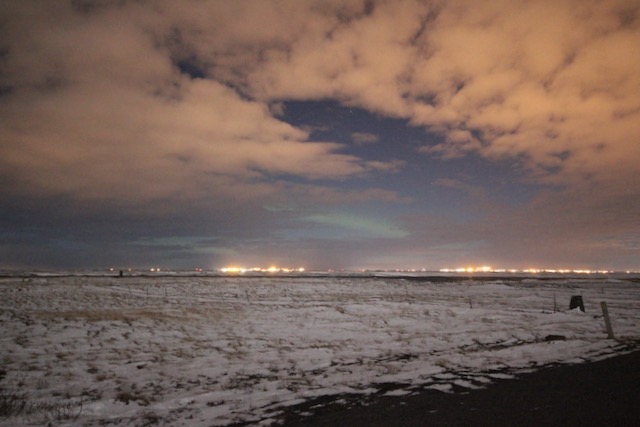
We saw the lights when we traveled to Iceland over Christmas and New Years, 2014-15. Our primary goal was to experience the holidays in a foreign c0untry, so we stayed in downtown Reyjavik. While there, we signed up for a Aurora tour where two busloads of folks rode out to a farm in the hinterlands to hunt auroras. The tour was nice since we didn’t have a car and the farm, as an off-season business, had a nice warm place and hot chocolate to recover from the 10-degree (F) temps outside. While there, we saw a wisp of the auroras:
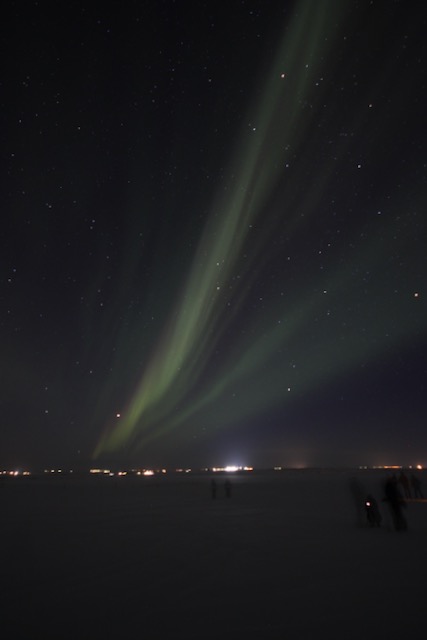
Interesting, but not “life changing” (and much of what you see is from a tripodded camera with a long exposure).
After a couple hours at the farm, we all loaded up and began our trip back to town. About halfway home, we could hear the tour guide and driver chattering excitedly in Icelandic. The guide suddenly grabbed the microphone, “The auroras have come alive! We are looking for a safe place to pull over!”
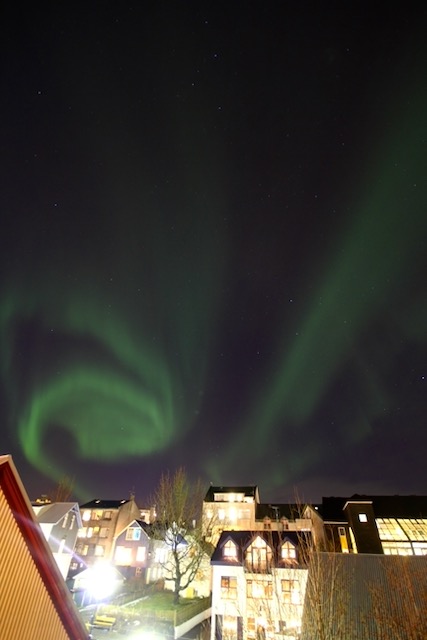
Holy. Moly. (see the first two photos of this post). These auroras were draperies that fluttered in the solar winds, mostly green with an occasional thin line of purple-red at the edge. Truly amazing and jawdropping. We were so lucky that our tour guides were more interested in us seeing the lights than getting back home that night.
It turned out that, for some reason, someone had flicked the Northern Lights switch on and we could even see auroras in town after that, a rare event (the city even shut off street lights to improve visibility).

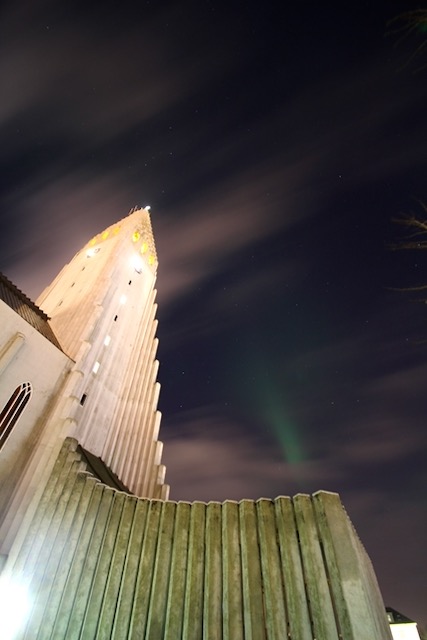
We were back in Iceland for New Year’s 2017-2018 and took another tour, this one on a shortbus. The visit was a bust although we could see a wisp behind the clouds toward Reykjavik.
If your goal is to see lights, I recommend going during the right time of the 11-year solar cycle and setting up shop out in the hinterlands with a hotel with a watcher. But also make sure you have other things lined up to see and do outside of viewing times such that if the trip is bust for the auroras, it’s not a bust for a nice trip to a new place.
 austin wanderlist